
Nicholas Joseph Clayton collection
Scope and Content of the Collection
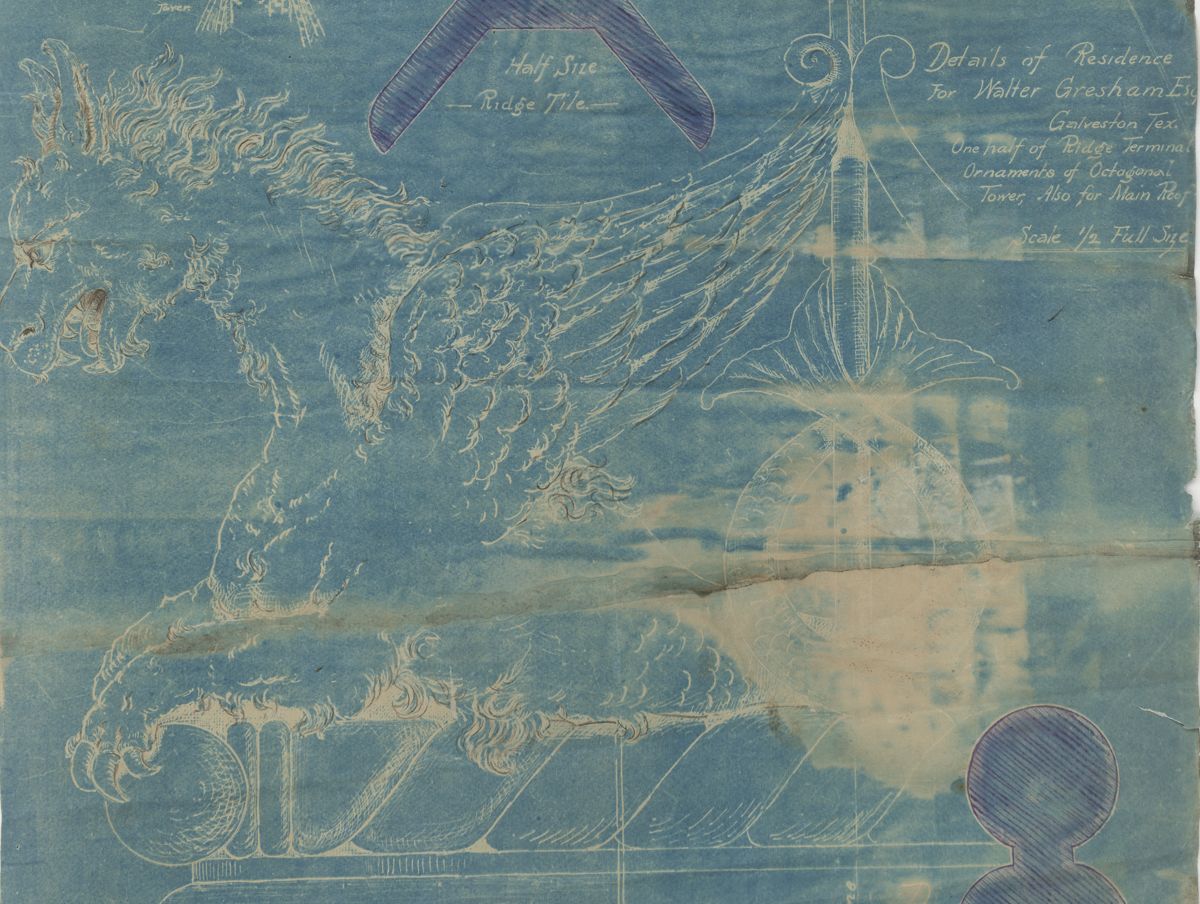
The Nicholas J. Clayton Papers contain 490 drawings (some unprocessed),.08 linear feet (1 inch) of archival material and one set of specifications, all dating from 1883 to 1901, for 18 projects which Clayton designed.
Other University of Texas collections containing Clayton related material include:
Alexander Architectural Archives. Texas Architectural Archive: Church of the Sacred Heart, Palestine, St. Edwards University Administration Building, Austin (poster), University of Texas Medical Branch at Galveston, Galveston.
Center for American History: Oral interview of Lucy Clayton (grand daughter).
Other institutions with Clayton holdings: Rosenberg Library (Galveston, Tex.) (74-0004). Papers, 1874-1915.
Dates
- Creation: 1883-1901
Creator
- Clayton, Nicholas Joseph, 1839-1916 (contributor, Person)
Policies Governing Use and Access
This collection is open for research. Researchers must register and agree to copyright and privacy laws before using archival materials. As all or portions of this collection may be housed off-site, advance notice of at least three working days is required for retrieval. Certain items may require additional time for flattening or humidifying before they can be viewed. Access is by appointment only. Please contact the archives' reference staff for further information.
Manuscript collections and archival records may contain materials with sensitive or confidential information that is protected under federal or state right to privacy laws and regulations. Researchers are advised that the disclosure of certain information pertaining to identifiable living individuals without the consent of those individuals may have legal ramifications (e.g., a cause of action under common law for invasions of privacy may arise if facts concerning an individual's private life are published that would be deemed highly offensive to a reasonable person).
The Alexander Architectural Archives operate in accordance with applicable federal or state laws and regulations, providing unrestricted access to university records not covered by state and federal right to privacy acts.
The Alexander Architectural Archives, The University of Texas Libraries, and The University of Texas at Austin, assume no responsibility for infringement of literary property rights and copyright or for liability to any person for defamation or invasion of privacy that results from a researcher's use of collections.
Researchers agree to indemnify and hold harmless The University of Texas at Austin, and their officers, employees, and agents from and against all suits, claims, actions, and expenses arising out of use of collections held by the libraries. Please alert staff if anything inappropriate is found during research.
Copyright interests in this collection may not have been transferred to the University of Texas. Researchers assume full responsibility for observing all copyright, property, and libel laws as they apply. Additionally, the public use of material must be cited. See citation information below.
Biographical Sketch of Nicholas J. Clayton
Nicholas J. Clayton was born in Cork, Ireland in 1840 and emigrated to Cincinnati, Ohio as a small child with his mother. He served in the United States Navy during the Civil War. After the war he went to Memphis, Tenn. where he studied with architect W.H. Baldwin at the firm, Jones and Baldwin. Late in 1872, Clayton traveled to Galveston on behalf of that firm to supervise construction of the First Presbyterian Church and the Tremont Hotel. He stayed in Galveston and established his own practice in 1875, making him one of the first professional architects in Texas. Clayton dominated Galveston architecture from 1873 to 1900, most prominently in the 1880s and 1890s.
While modest in personal conduct, Clayton assiduously promoted his architectural practice. From 1884 until 1902, each successive edition of Morrison & Fourmy's Galveston City Directory contained his full-page advertisement, illustrated with engravings of the architect's work. His office day book recorded the transmittal of notices on current projects to both Galveston and Houston newspapers.
Clayton was involved in the design of most building types of the period. Institutional, commercial, industrial, ecclesiastical and residential buildings all became subjects for his spirited, picturesque, eclectic treatment. From 1880 to 1900, his work, although stylistically varied, was consistently informed by a High Victorian sensibility. This entailed a richly plastic manipulation of building surfaces, deployed in aggressively mannered, renditions of the Gothic revival, the pre-Richardsonian Romanesque, and neo-Grec classicism.
Richardson's influence began to show in Clayton's work of the late 1880s and 1890s, as did the suburban Queen Anne, and the developing school of Renaissance classicism. Yet, even though these later tastes were predicted on the priority of massing and composition over ornament, Clayton sacrificed none of this exuberance in dealing with them. In contrast, his planning was simple and pragmatic. An academic distribution of space in institutional structures, and unencumbered loft space in commercial buildings were typical of his work. Only in churches and houses was his planning highly articulated.
After 25 years as the first architect of the city, Clayton, for a variety of reasons, suffered a swift and painful professional decline just after the turn of the century. When he died, in 1916, at the age of 76, his burial site was marked with one of his marble samples because his family could not afford a gravestone. Yet his bequest to Galveston and to the other cities which have retained his buildings is of irreplaceable value. His work represents a lifetime, worked out day by day under the most ordinary and circumstantial conditions, dedicated to the cause of architecture as the public art.
Sources:
Fox, Stephen. "Profile: Nicholas J. Clayton, Architect." Texas Architect 26 (July/August 1976): 51-52.
Fox, Stephen. "Texas 7." Architectural Review (November 1978).
Nesbitt, Robert A. The Port of Galveston Bicentennial Appointment Calendar and Compendium for 1976. [Galveston: private printing, 1976].
Partial Extent
0.08 Linear Feet
Partial Extent
490 drawings
Language of Materials
English
Abstract
Nicholas Clayton (1839-1916) was one of the first professional architects to establish a practice in Texas and is most famous for his work in Galveston between 1873 and 1900. Drawings, sketches, and specifications a selection of projects designed by Clayton.
Other Finding Aids
Unpublished inventory in Archive.
Acquisition Information
Transferred to the Alexander Architectural Archives from the University of Texas at Austin, School of Architecture.
References to works by or about Nicholas J. Clayton (1840-1916)
- Alexander, Drury Blakeley. Texas Homes of the Nineteenth Century. Austin: University of Texas Press, 1966.
- Barnstone, Howard. The Galveston that Was. New York: Macmillan, 1966.
- Robinson, Willard E. Texas Public Buildings of the Nineteenth Century. Austin: University of Texas Press, 1974.
- Speck, Lawrence. Landmarks of Texas Architecture. Austin: University of Texas Press, 1986.
- Nicholas J. Clayton papers, 1874-1915. Rosenberg Library, Galveston, Tex.
Processing Information
Drawings are not completely processed. For more information, please contact Archives' staff.
Collection Processors
Drawings processed by: Lila Stillson and Hugh Boren
Date: Fall 1983
Processed by: Nancy Sparrow
Date: October 1992
Subject
- Clayton, Nicholas Joseph, 1839-1916 (contributor, Person)
- Dallas Orphan Asylum (contributor, Organization)
- Galveston News Building (contributor, Organization)
- Hutchings-Sealy Building (contributor, Organization)
- St. Patrick's Catholic Church (Galveston, Tex.) (contributor, Organization)
- Ursuline Convent (Dallas, Tex.) (contributor, Organization)
- St. Matthews Catholic Church (Monroe, La.) (contributor, Organization)
- Ball High School (Galveston, Tex.) (contributor, Organization)
- Title
- Nicholas Joseph Clayton collection
- Author
- Inventory prepared by Lila Stillson, Hugh Boren, Nancy Sparrow
- Date
- 1983, 1992
- Language of description
- English
- Script of description
- Latin
Repository Details
Part of the Alexander Architectural Archives Repository
University of Texas Libraries
101 E. 21st Street
Austin Texas 78712 United States
(512) 495-4621
apl-aaa@lib.utexas.edu